Knot-hole
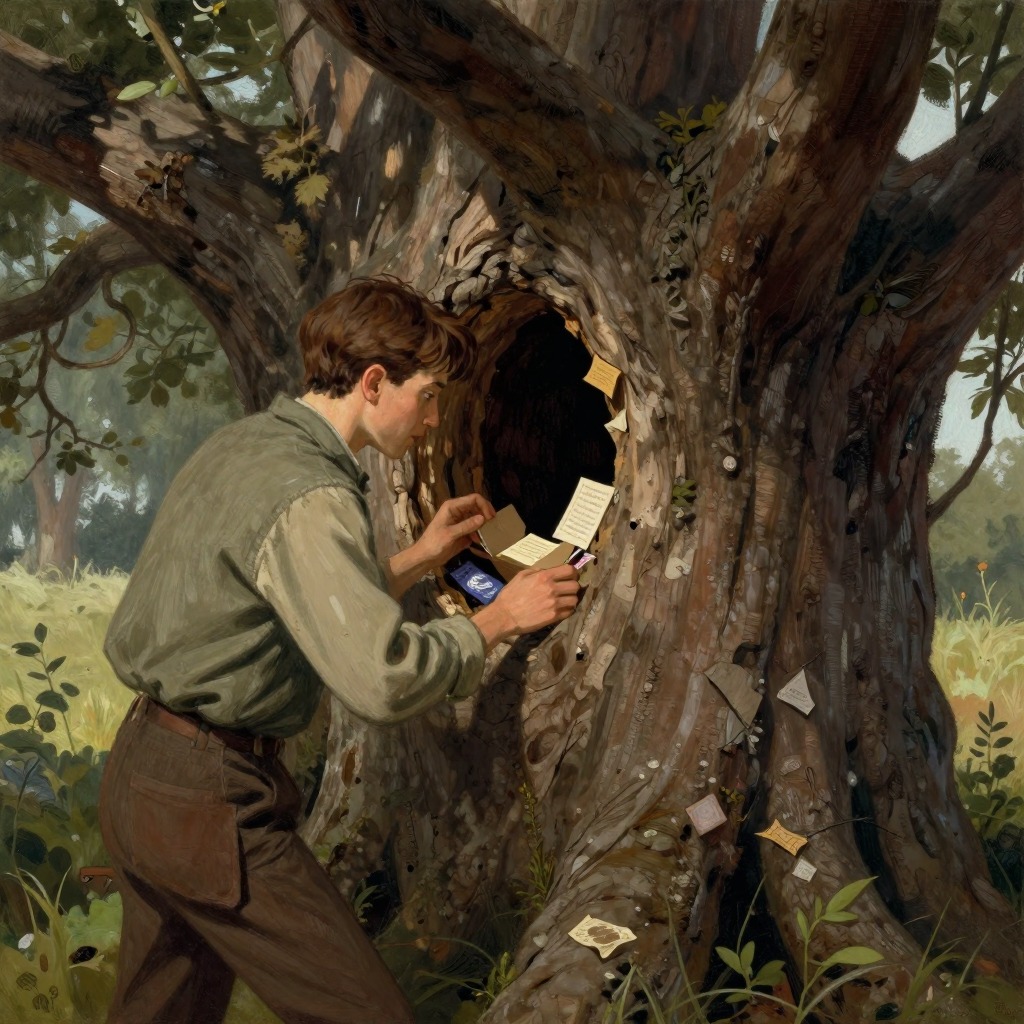
The knot-hole in the live oak tree at the corner of the Radley Place is one of the most potent objects in Maycomb, functioning as a secret passage of communication between the reclusive Boo Radley and the Finch children, Jem and Scout. For a season, this small cavity in the tree becomes a repository of mysterious gifts, a source of wonder and speculation, and ultimately a site of loss that crystallizes the children's understanding of adult cruelty and hidden benevolence. Its cementing by Mr. Nathan Radley marks a definitive end to an innocent, reciprocal relationship and deepens the mystery of the man who never shows his face.
Discovery and the Gifts
The knot-hole first enters the children's lives as a natural part of their daily orbit. On a mild October afternoon, Jem and Scout, trotting home from school, find something white inside the hole. Jem lets Scout do the honors, and she pulls out two small images carved in soap: one a boy, the other a girl in a crude dress. Initially frightened by what she thinks might be hoo-doo, Scout throws them down, but Jem snatches them up, declaring them "good" and noting they are "almost perfect miniatures" of the two children. The boy-doll has a shock of soapy hair falling to his eyebrows, matching Jem's own straight brown hair that kicks downward from his part; the girl-doll wears bangs, just like Scout. "These are us," Jem concludes. The identity of the carver becomes a puzzle: Jem dismisses Mr. Avery, who only whittles stovewood into toothpicks, and Miss Stephanie Crawford's sweetheart, who lives too far away to pay them any attention. Jem puts the dolls in his trunk. Less than two weeks later, the knot-hole yields a whole package of chewing gum, which the children enjoy, the fact that everything on the Radley Place was poison having slipped Jem's memory. The following week, a tarnished spelling medal appears. Atticus identifies it as a relic from the Maycomb County schools' spelling contests, held before the children were born, and suggests someone must have lost it. Their biggest prize arrives four days later: a pocket watch that won't run, on a chain with an aluminum knife. Atticus estimates it would be worth ten dollars if new. Jem, who carries his grandfather's watch only once a week with great care, asks if he can keep this one instead, hoping to fix it. He does a fair job, only one spring and two tiny pieces left over, but the watch will not run.
The Letter and the Cementing
The children decide to write a letter to their anonymous benefactor. Jem drafts it: "Dear sir... We appreciate everything which you have put into the tree for us. Yours very truly, Jeremy Atticus Finch." Scout suggests the recipient won't know who he is if he signs it that way, so Jem erases his name and writes "Jem Finch," and Scout signs "Jean Louise Finch (Scout)" beneath it. Jem puts the note in an envelope. The next morning on the way to school, Jem runs ahead and stops at the tree. When he looks up, Scout sees him go stark white. Someone has filled the knot-hole with cement. "Don't you cry, now, Scout," Jem mutters all the way to school. That afternoon, Jem bolts his food and stands on the porch, watching for Mr. Nathan Radley. The next day, he repeats his vigil and is rewarded. When Mr. Radley passes, Jem asks him directly: "Mr. Radley, ah- did you put cement in that hole in that tree down yonder?" Mr. Radley answers, "Yes. I filled it up." When Jem asks why, Mr. Radley explains, "Tree's dying. You plug 'em with cement when they're sick. You ought to know that, Jem." Jem says nothing more until late afternoon, when he gives the tree a meditative pat on its cement. That evening, he asks Atticus to look at the tree. Atticus examines it and declares it healthy: "Look at the leaves, they're all green and full, no brown patches anywhere." When Jem insists Mr. Nathan Radley said it was dying, Atticus replies, "Well maybe it is. I'm sure Mr. Radley knows more about his trees than we do." Jem leans on a pillar, rubbing his shoulders against it, and stands there until nightfall. When they go inside, Scout sees he has been crying; his face is dirty in the right places, but she had not heard him.
Significance and Aftermath
The knot-hole's cementing is a pivotal moment in the children's moral education. It represents the first deliberate, adult act of exclusion they witness, a shutting down of a mysterious but benevolent connection. The gifts—the soap dolls, the chewing gum, the spelling medal, the broken pocket watch—were not merely trinkets but tokens of a hidden, caring presence. The children's attempt to reciprocate with a letter is thwarted before it can be delivered, leaving the communication permanently one-sided. The lie about the tree being sick, exposed by Atticus's truthful observation, reveals Mr. Nathan Radley's active hostility toward the children's contact with Boo. This event foreshadows the larger, more violent acts of exclusion and injustice that will unfold in the trial of Tom Robinson. The knot-hole itself becomes a symbol of the unseen good that exists in Maycomb, a good that is deliberately suppressed by the forces of fear and social control. Later, during the fire at Miss Maudie's house, Boo Radley's silent act of placing a blanket around Scout's shoulders confirms that the gifts were his, and that his kindness persists even after the knot-hole has been sealed. The knot-hole, though filled with cement, remains a powerful memory of a secret friendship that transcended the walls of the Radley Place.